 11
11
Perimenopause is a transitional phase that many women experience in their 40s (and sometimes late 30s), leading up to menopause. During this time, hormone levels begin to fluctuate—especially estrogen and progesterone—causing a wide range of physical and emotional symptoms.
Many women report weight gain, fatigue, mood swings, sleep problems, and stubborn belly fat. This raises an important question:
Can strength training help balance hormones during perimenopause?
yes, it can help significantly—but not by directly “fixing” hormones. Instead, it supports your body in ways that improve hormonal balance naturally.
In this guide, we’ll break down how perimenopause affects hormones and how strength training becomes one of the most powerful tools for managing symptoms and restoring balance.
Perimenopause is the stage before menopause when the ovaries gradually produce less estrogen. It can last anywhere from 4 to 10 years.
These symptoms are caused by fluctuating hormone levels, not just low hormones.

Estrogen helps regulate:
During perimenopause, estrogen becomes unstable—sometimes high, sometimes low—causing unpredictable symptoms.
Progesterone has a calming effect on the body. When levels drop:
Cortisol is the stress hormone. During perimenopause:
Insulin helps regulate blood sugar. Hormonal shifts can lead to:
Strength training does not directly “reset” hormones—but it creates the conditions for a healthier hormonal environment.
It improves:
In simple terms, lifting weights helps your body function better, which leads to improved hormonal balance.
During perimenopause, estrogen fluctuations can cause fat to accumulate around the abdomen.
Strength training helps by:
This leads to better body composition and less hormonal weight gain.
Chronic stress is one of the biggest hormonal disruptors in perimenopause.
Strength training helps:
\text{Regular Strength Training} \; \rightarrow \; \downarrow \text{Cortisol Stability} \; \rightarrow \; \text{Reduced Belly Fat Storage}}
Lower cortisol means fewer stress-related symptoms like belly fat, fatigue, and poor sleep.
Muscles act like a sponge for glucose.
When you strength train:
This helps prevent weight gain and energy crashes.

Estrogen decline increases the risk of osteoporosis.
Strength training:
This is especially important during and after perimenopause.
Many women struggle with unexplained weight gain during perimenopause.
Strength training helps by:
More muscle = more calories burned daily.
Hormonal fluctuations often cause mood swings and anxiety.
Strength training:
Even short workouts can significantly improve mood.
Sleep issues are common in perimenopause due to hormonal imbalance.
Strength training helps:
Better sleep leads to better hormone regulation.
Focus on full-body, functional movements:
These exercises improve strength and hormonal health together.
For best hormonal benefits:
Overtraining can increase cortisol, so balance is key.
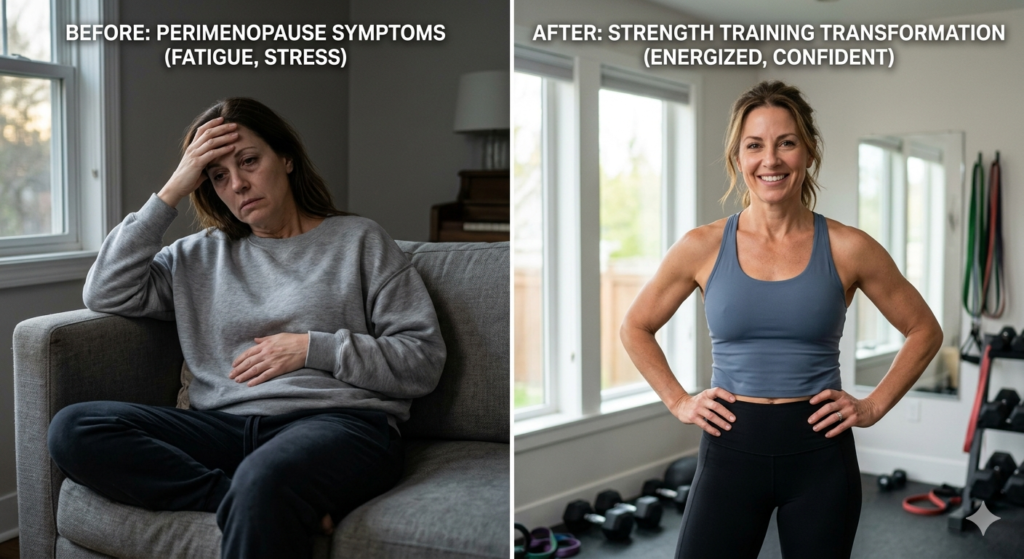
Day 1: Full Body
Day 2: Rest or Walking
Day 3: Full Body
Day 4: Rest
Repeat weekly.
Supports muscle and hormone health:
Essential for hormone production:
Carbs help regulate cortisol and energy levels.
Hydration supports metabolism and hormone function.
Cardio alone does not support hormonal balance as effectively as strength training.
Too much exercise increases cortisol.
Recovery is essential for hormonal health.
Undereating can worsen hormonal imbalance.
With consistent strength training:
Hormonal balance improves gradually over time.
So, does strength training balance hormones in perimenopause?
The answer is yes—indirectly but powerfully.
Strength training helps your body:
It doesn’t replace hormones—but it helps your body respond to hormonal changes in a healthier, more balanced way.
For women in perimenopause, lifting weights is not just exercise—it’s one of the most effective tools for long-term health, confidence, and stability.
Yes, it can significantly reduce symptoms like weight gain, mood swings, and fatigue.
2–4 days per week is ideal.
Yes, strength training provides stronger long-term hormonal benefits.