 11
11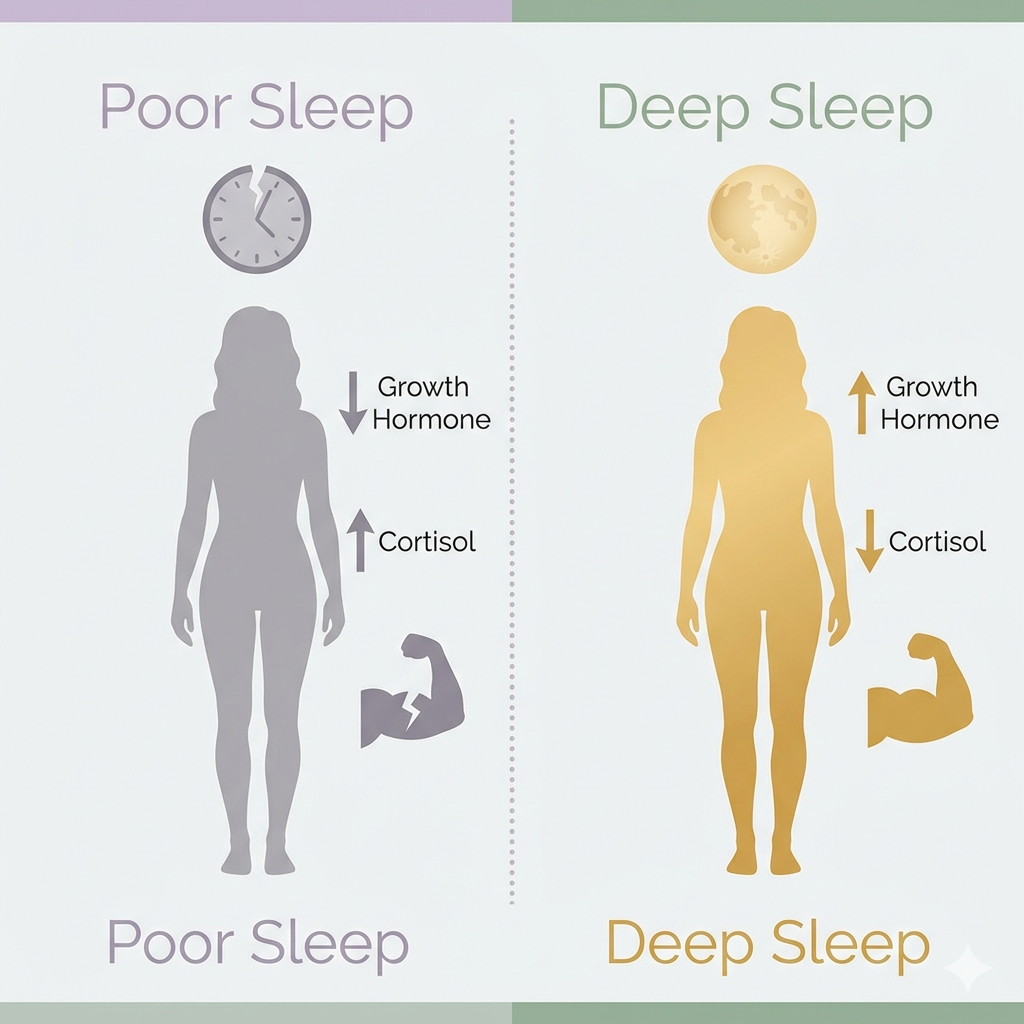
You track your protein. You lift weights three times per week. You drink the water. You do everything “right.” And yet the muscle gains are painfully slow. The scale hasn’t moved. Your arms still feel soft.
Here is what almost every fitness plan gets wrong for women over 40: It ignores sleep.
You have been told that muscle is built in the gym. That is only half true. The gym is where you break down muscle. Sleep is where you build it back stronger. And for a woman over 40, sleep is not a luxury. It is a biological necessity—as important as the workout itself.
If you are sleeping six hours or less, you are quite literally canceling out the benefits of your strength training. No amount of protein powder can fix broken sleep.
This article explains exactly why sleep becomes the secret weapon for muscle building after 40, and gives you a practical, over-40-specific plan to fix your rest.
Let us start with the biology you were never taught.
When you lift weights, you create microscopic tears in your muscle fibers. That sounds bad, but it is the entire point. Your body responds to those tears by repairing the damage and adding a little extra tissue so the muscle is stronger and ready for next time. This is called muscle protein synthesis (MPS) .
Here is the catch: MPS is not active during the day while you are awake. It is turned on almost exclusively during deep sleep.
| Sleep Stage | What Happens to Your Muscles |
|---|---|
| Light sleep (NREM 1 & 2) | Heart rate slows, blood pressure drops, blood flow to muscles begins to increase |
| Deep sleep (NREM 3) | Growth hormone is released; muscle protein synthesis peaks; damaged cells are repaired |
| REM sleep | Recovery of the nervous system; motor skill consolidation (you literally “learn” the movement patterns from your workout) |
Without enough deep sleep, your body never enters the repair phase. Those microscopic tears stay torn. You stay sore. And you never build the muscle you worked so hard to create.
You are not imagining it. Sleep truly does get harder after 40. And it is not your fault.
Progesterone is a sleep-promoting hormone. It has a calming, sedating effect on the brain. As progesterone declines during perimenopause and menopause, many women find it harder to fall asleep and stay asleep.
What that means for you: Your natural “sleep switch” is weaker. You cannot rely on your body to drift off easily anymore. You need to actively create sleep conditions.
Up to 80% of women experience hot flashes or night sweats during perimenopause. These are not just uncomfortable—they are sleep disruptors. Each hot flash can wake you up, even if you do not fully remember it in the morning.
What that means for you: You might think you slept seven hours, but your body experienced multiple micro-awakenings. Your deep sleep was fragmented. Your muscles did not get a continuous repair window.
Remember cortisol from the recovery article? It also ruins sleep. Chronic stress keeps cortisol high at night when it should be low. High nighttime cortisol suppresses deep sleep and growth hormone release.
What that means for you: You feel “tired but wired.” Exhausted enough to want to sleep, but too anxious or wired to actually fall into deep rest.
Melatonin is your body’s “darkness signal” that tells you it is time to sleep. After 40, your natural melatonin production decreases. You produce less, and you produce it later in the evening.
What that means for you: Your internal clock has shifted. Falling asleep at 10 PM becomes harder. Staying asleep until 6 AM becomes harder.
Let us get specific. This is not vague wellness advice. These are measurable effects.
| If You Sleep… | What Happens to Muscle Growth |
|---|---|
| 7–9 hours | Optimal growth hormone release; full muscle repair; normal cortisol rhythm |
| 6–7 hours | 20–30% reduction in growth hormone; partial muscle repair; slightly elevated cortisol |
| 5–6 hours | 50–60% reduction in growth hormone; significant muscle breakdown; high cortisol |
| Under 5 hours | Muscle protein synthesis nearly stops; body enters catabolic (muscle-wasting) state |
But wait, there is more. Poor sleep also affects:
Translation: Skimping on sleep does not just slow muscle growth. It actively encourages fat storage and muscle loss. It is a double disaster for women over 40.
Enough bad news. Here is your actionable plan to fix sleep and unlock muscle growth.
Your body craves consistency. Going to bed at 10 PM on weeknights and 1 AM on weekends confuses your internal clock. This is called “social jetlag,” and it is just as damaging as real jetlag.
The fix: Choose a bedtime and wake time. Stick to them within 30 minutes every single day, including weekends. It takes about two weeks for your body to adjust. Be patient.
The over-40 specific hack: Aim to be in bed by 10 PM. Your deepest, most restorative sleep happens between 10 PM and 2 AM. If you miss that window, you cannot “make it up” later.
You cannot go from answering emails to sleeping. Your brain needs an off-ramp.
The fix: One hour before bed, do these three things:
What to avoid: Scrolling social media, watching action movies, checking work email, arguing with your partner.
Hot flashes and night sweats are worse in warm rooms. Your body needs to drop its core temperature by 1–2 degrees to fall asleep and stay asleep.
The fix: Set your thermostat to 65–68°F (18–20°C). If you control the bedroom but not the whole house, use a portable AC unit or a ceiling fan pointed directly at you.
The over-40 specific hack: Invest in a cooling mattress topper (gel or phase-change material) and moisture-wicking sheets (bamboo or Tencel, not cotton or flannel). These are not luxuries. They are medical devices for perimenopausal sleep.
You do not need prescription sleep meds. They disrupt natural sleep architecture and are habit-forming. Try these evidence-based alternatives first.
| Supplement | Dose | Timing | Why It Works |
|---|---|---|---|
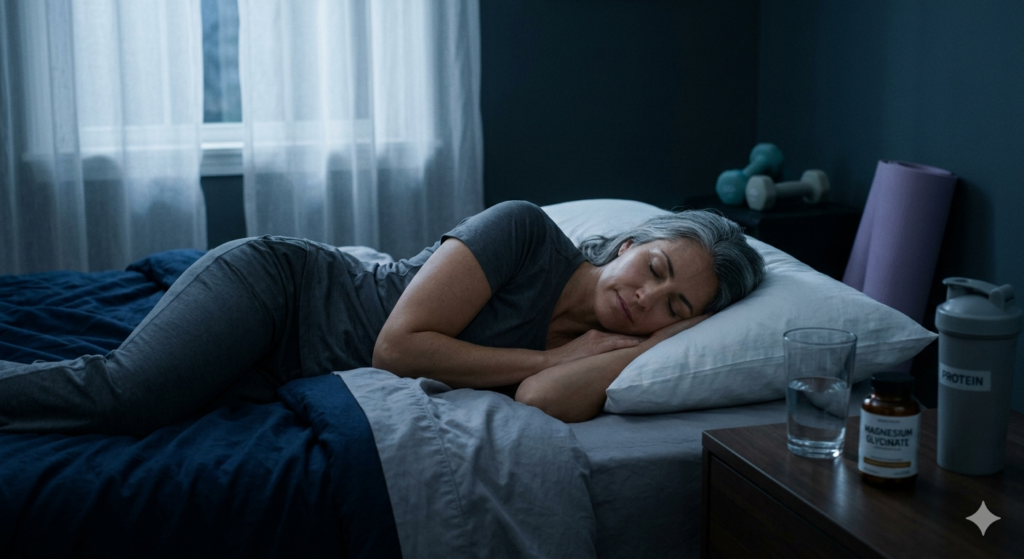
| Magnesium glycinate | 300–400mg | 60 min before bed | Calms the nervous system; reduces night sweats; improves deep sleep |
| Tart cherry juice | 8 oz | 30 min before bed | Naturally increases melatonin; reduces inflammation |
| L-theanine | 100–200mg | 60 min before bed | Lowers stress without drowsiness; improves sleep quality |
Start with magnesium glycinate alone for one week. Then add tart cherry if needed. L-theanine is optional for high-stress periods.
What you eat affects how you sleep. And how you sleep affects your muscle growth.
The fix:
The over-40 specific hack: If night sweats are severe, avoid spicy foods, caffeine after 12 PM, and alcohol completely for two weeks. Track your symptoms. Many women see dramatic improvement.
Your sleep-wake cycle is set by light exposure. Bright light in the morning tells your body “daytime is here.” That starts a 14–16 hour timer for melatonin release.
The fix: Within 30 minutes of waking, go outside for 10–15 minutes. Do not wear sunglasses. Do not look through a window (glass blocks the specific wavelengths you need). Just be outside.
Cloudy day? Still works. Rainy day? Still works. The light intensity outdoors, even on a gray day, is 10–100x brighter than indoor lighting.
Let us put it all together.
| Time | Action | Why |
|---|---|---|
| 6:30 AM | Wake up, go outside for 15 min morning sunlight | Sets circadian clock for better sleep tonight |
| 12:00 PM | Last caffeine of the day (coffee or tea) | Caffeine half-life is 5–6 hours |
| 6:00 PM | Finish dinner (protein + carbs + veggies) | Digestion complete before bed |
| 8:30 PM | Dim lights, put phone away, take magnesium | Start wind-down |
| 9:00 PM | Light stretch or read a physical book | Calm nervous system |
| 9:30 PM | Tart cherry juice (8 oz) + cooling bedroom to 67°F | Prepares body for deep sleep |
| 10:00 PM | Lights out | Deep sleep window begins |
You cannot supplement your way out of bad sleep. You cannot train your way out of bad sleep. You cannot eat your way out of bad sleep.
Sleep is the foundation. Everything else—protein, strength training, hydration, recovery—sits on top of it. If the foundation cracks, the whole house crumbles.
For women over 40, sleep is not just about feeling rested. It is the primary driver of muscle growth, fat loss, and hormonal balance. Every hour of deep sleep is an hour your body is actively building the strong, capable physique you are working for.
Stop treating sleep as the thing you sacrifice to get more done. Start treating it as the most productive hour of your day.
Because here is the truth: The woman who sleeps eight hours will build more muscle than the woman who workouts twice as hard but sleeps six. Every single time.
Protect your sleep. Build your muscle. Thrive after 40.

Disclaimer: This article is for educational purposes only and does not constitute medical advice. Always consult a healthcare provider before starting new supplements or making significant changes to your sleep routine, especially if you have underlying health conditions or are taking medications.